Kp: 1.67 | Bz: 1.32

Alaska Northern Lights Forecast & Kp Index Tools
27-Day Aurora Forecast
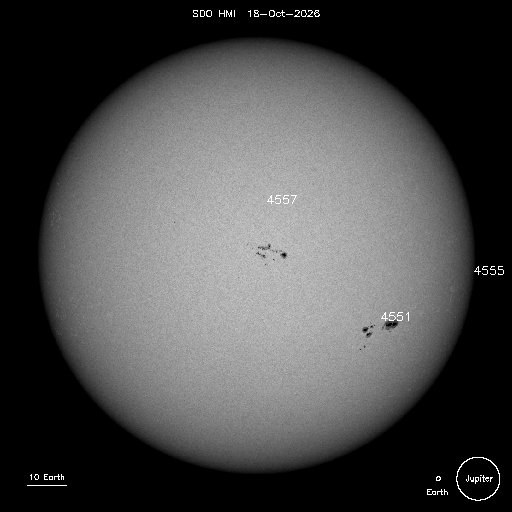
Our 27-day aurora forecast tool is great for predicting auroras. On average, the sun rotates on its axis once every 27-28 days as seen from Earth. Therefore, sunspots, like those seen on the solar image to the left, are like a giant revolving firehose emitting energy into space for sometimes months at a time.
After an active aurora night, mark that date on a calendar and in 27-28 days pay close attention to the sky. If that same sunspot (or coronal hole) is still active it will have rotated around with the sun and will be, once again, in geoeffective position (pointing toward Earth)....and hosing us with an enhanced flow of aurora-generating solar wind.
11-Year Solar Cycle
The sun has a heartbeat. Every eleven years or so it beats, and it beats hard. This is known as the solar cycle and is measured by the number of sunspots visible on the sun. The more sunspots, the more solar flare energy is being released into space (which means more aurora activity!).
For 400 years, from the time of Galileo until now, we have been keeping track of the number of these sunspots and, as the trends show in these two graphs, this cycle is predictable.
Q: Where are we now on the solar cycle?
A: We're currently coasting down from the peak of the Solar Cycle - but history suggests this is when the sun throws some epic aurora parties. This magnetic reversal causes the sun to eject a lot of charged particles into the solar wind. This is good news for aurora hunters because the solar-released energy is the generating force of the aurora. The next few “peak phase” years should all be good.
Best Months?
Aurora Borealis season in northern polar latitudes (Alaska, northern Canada, Greenland, Iceland, Norway, Sweden, Finland and Siberia) runs from August-thru-April. These are the nights with darkness in them. During the summer months of May, June and July it is just too bright to see them in the far northland. Auroras can still be spotted south of about 50° latitude during the summer.
Statistically, the equinox months of September and March are best for aurora activity. The winter months of October-thru-February are also good (there is definitely no shortage of darkness!).
Mythbuster: Contrary to popular belief, it does not have to be cold to see the aurora, just dark and clear....and clear skies usually mean it’s cold, hence the association between auroras and chilly nights.
What Time of Night?
The peak hours are between 11pm and 2am, however, anytime it’s dark there is hope. I've seen the northern lights as early as 8pm and as late as 8am.
Real-Time
Listed below are some websites of organizations that monitor the sun, measure the solar wind in real-time (now), and make aurora predictions. In the explosive event that a coronal mass ejection (CME) is reported it's time to hop into action because this super-charged solar wind is traveling fast (maybe 3-to-5 million miles per hour). When this energy sweeps by the earth 1-to-3 nights later there is a very good chance of aurora activity. It pays to stay tuned in.
Aurora Forecasting Tools
Saturday, 10/17/2026
Northern Lights Prediction Page
Current Kp Index
2hr Max: 2.67
Planetary K-index
Observed + forecast (hatched)
Interplanetary Magnetic Field Bz1.2 nT now
Last 24h. Southward (negative) Bz favors aurora.
27-Day Kp Outlook
NOAA's largest-Kp outlook for one full solar rotation (27 days).
Interactive Aurora Globe
Aurora Photography by Todd Salat
Original prints from Todd Salat's collection.

Blood Moon
Denali National Park, Alaska · 2025

Catch of the Day
Seward, Alaska · 2023

Denali Spectacle
Denali Viewpoint South, Alaska · 2023